I’ve been using a Hobonichi techo for personal recordings every year, but I only had a Weeks twice in 2020 and 2021. I don’t know why I stopped, but I have renewed with the Weeks in 2026, and I’m loving it so so much! It’s the notebook/agenda that I decorate the most with stickers and washi tape, and it’s also the more pleasant to look at. I just love opening it every day.
There are a bunch of blank pages at the end of the Weeks, and I didn’t know how to use them, but then I realised it would be the perfect place to have those general spreads people usually do at the beginning of their yearly reading journal.
I am still on my three Midori notebooks as reading journals (one for each language), so there is no place for me to do those general spreads like “books read this year”, favourite authors, etc. And given that the Weeks is going to last the entire year, it seemed perfect!
The first spread is my reading goal for 2026. I rarely do a numerical goal, but I thought, why not this time! I think it’s a reasonable challenge to target 4 books per month, so a total of 50 books sounds good.

Following my language challenge, I want to see how many books I read in each language in 2026, so I’m attributing a colour for each book depending on their language. I just used the same colours as the tags I had randomly chose in Notion, so there’s not much thought into it. And in the end, I decided to separate Simplified and Traditional Chinese with two shades of the same colour. The blank space will be used to draw some kind of podium or chart at the end of the year to see which language won the competition (but both Simplified and Traditional will be counted as Chinese).
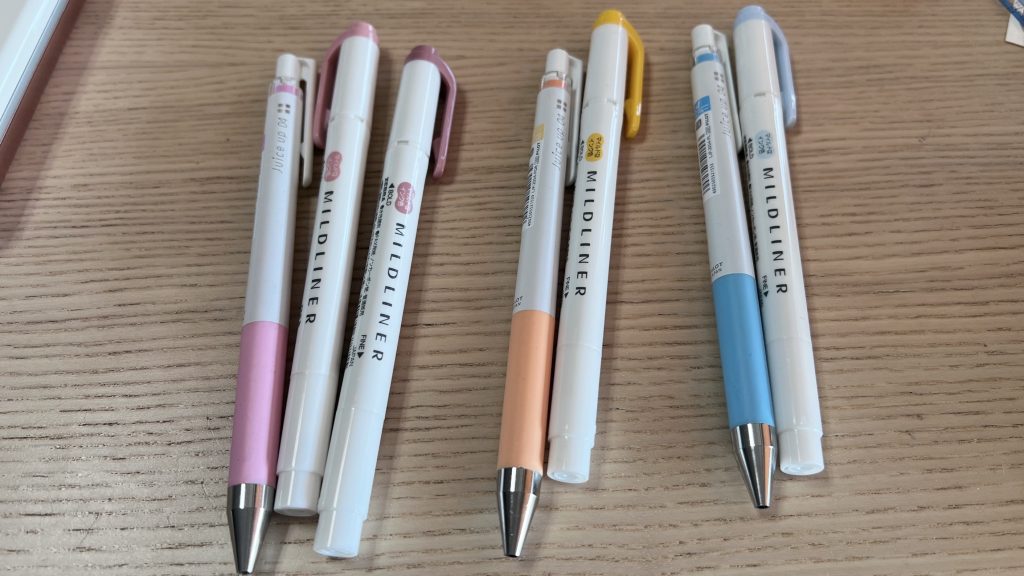
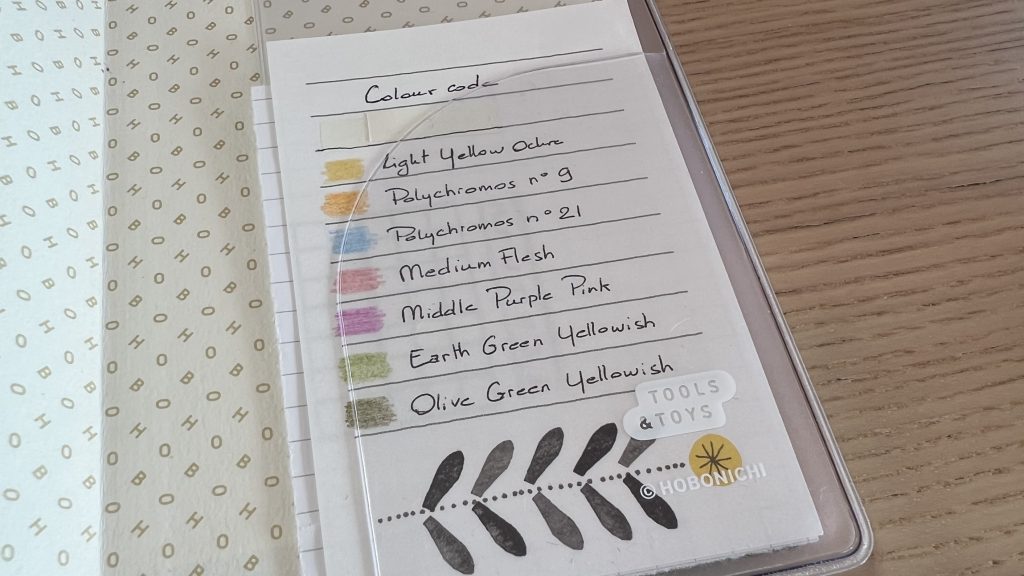
I had a bunch of Juice Up pens that match the colours, and I had to buy a couple of Midliners to go with them. I also use coloured pencils and did a colour chart that I keep at the end of the Weeks.
I also have spreads for “Favourite books of 2026”, “Favourite authors of 2026” and “Favourite fictional characters of 2026”, but they are empty for now.
For “favourite authors”, I’m thinking of adding a list of books by these authors that I plan to read. As for “favourite fictional characters”, I’ll probably just write one or two sentences to explain why I love them.
Next spread is simply a list of books read in 2026. For now I just have the cover, title highlighted with the corresponding colour, author and date finished. I’m thinking of adding a rating, not of the book, but of my enjoyment while reading the book. So stars don’t seem that appropriate, maybe just coloured dots would be okay?

And I changed my mind about printing mini covers. I realised that it was not as expensive as I thought because I can print several covers on the same sheet. So for example here, the big cover will go in my reading journal for this book entry, and the four small ones are for the spread above. The colours are actually much better in reality than it looks like on the picture.

Then I have a page per month with a mini calendar. This is totally redundant with the monthly calendar at the beginning of the Weeks, I’m perfectly aware of that haha. I just wanted to try, because it looks so cool. I only add dots of colour for the days I finish a book and the days I post on my blog. Then I’ll probably add a cover of my favourite book of the month and write a list of all the books read that month. Maybe also general notes about the month (for example, I’ve been sick the first two weeks of January, so this has affected my reading).

At the end of the monthly pages, I have a monthly tracker to count the number of books read each month. Again, using the colour corresponding to the language in which I read each book. Now it will absolutely hurt my soul if I ever read more than 5 books in a month… I counted on my trusty slow reading pace to never allow me to go past 5 books.

And then comes the fun part: my reading bingo (I called it reading challenge, but it’s more a form of bingo).
I took inspiration from the Mystery/Thriller Challenge created by juliana_caterin on Storygraph, and added my own prompts.
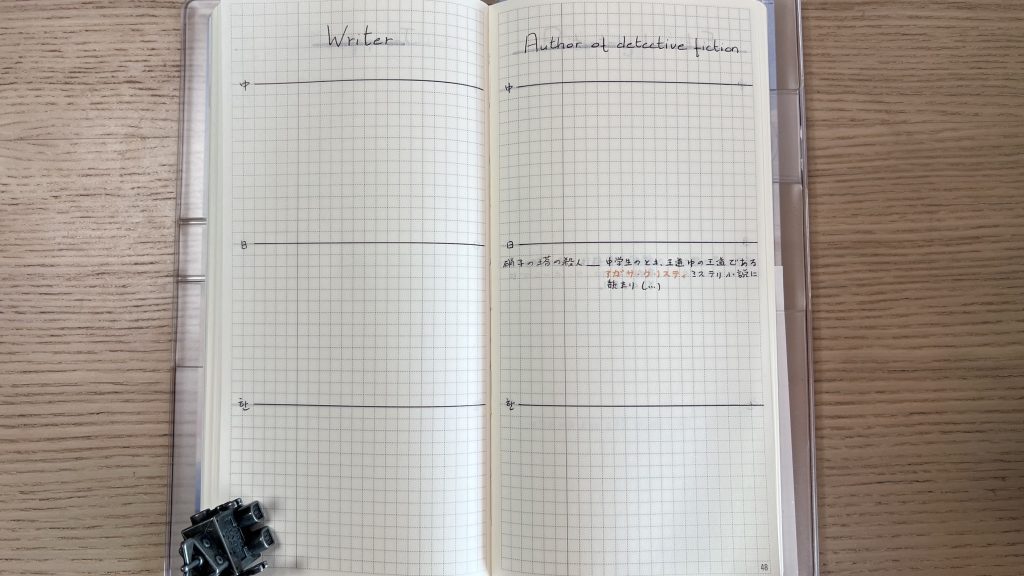
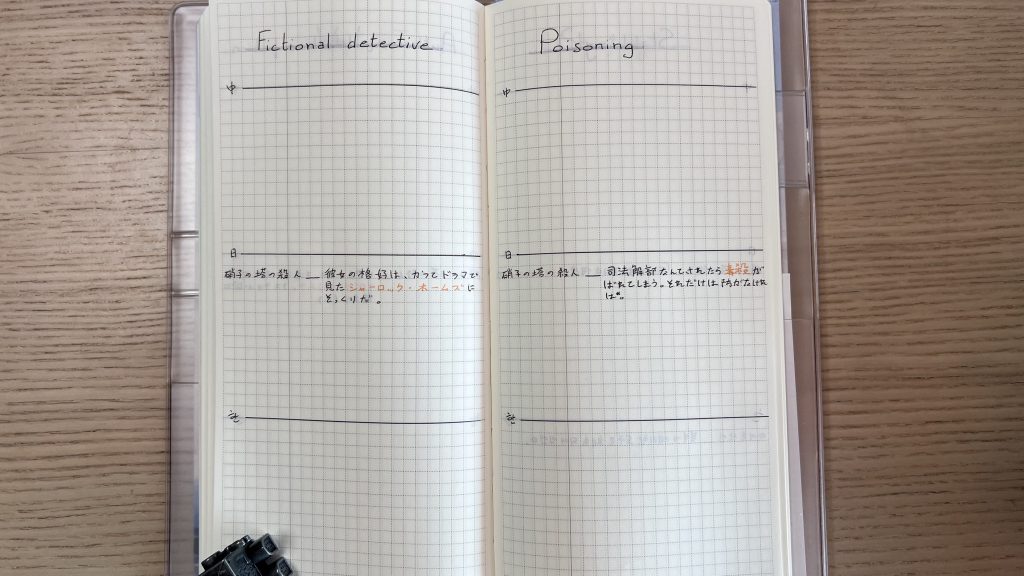
I add the title at the top of the page and leave space for each language. If I encounter the prompt in question while reading, I write down the sentence that mentions it, in the corresponding space (it might be difficult to see ont he picture but it goes: 中, 日 and 한). I decided to highlight the words mentioning the prompt in the corresponding colour, but half of the time I forget to switch pen. I have a bingo when all three languages are filled, and mention of serial killer is the closest to a bingo so far.

I did leave space to add several entries, otherwise it would be filled very quick and wouldn’t be as fun. Especially since I started the year with Japanese novel 硝子の塔の殺人 by 知念 実希人 (Chinen Mikito), and it goes over all the classic tropes of mystery fiction, so this book alone has checked a lot of entries for Japanese…
Some fun ones are “challenge to the reader” (I still haven’t found any, but I’m 100% sure I will see some this year), one I called “among us” for when characters suddenly realise that the murderer must be one of them, and I have a lot of cherished tropes of detective fiction like footsteps in snow or dying message. I also added the different ways murder can be committed. Oh, and one prompt is “de mortuis nil nisi bonum” for when a character is interrogated about the victim and starts by saying “I know you don’t speak ill of the dead, but…” and then proceeds in gossiping about the victim. I thought this one might be a bit specific and difficult to find, but I actually already found a mention in a Korean novel!

I have also have a category for books mentioning another author of detective fiction, and one for mentions of famous fictional detectives. It’s almost always Christie and Holmes, but again 硝子の塔の殺人 checked both prompts in like, the first 10 pages?
And finally I have a bonus one: “horse” for 2026! I doubt I’ll find this one (Japanese might be favoured given that horse racing is popular there and might be used in a plot), but it’s a fun one.
I actually regret to have chosen prompts related to crime fiction, because obviously, I’m filling them very fast, so it’s not as suspenseful as it could be. I’ll probably do it again next year with completely other prompts, either random stuff like “washing machine mentioned!” or something more fun.
I might also call a super bingo pages that have 3 entries per categories… or maybe the real goal is to get the Horse bingo! Though to be fair, I tend to forget about these prompts when I’m reading, so there’s probably a lot of missed entries already. But it’s just for fun, so it doesn’t matter.
I only have three pages left blank where I can add new prompts if I think of interesting new ones. It’s the first time I’m completely using the Weeks pages.
It’s also the first time I’m doing this kind of thing, so obviously there are a lot of things I’m not happy about (layout mostly), but I’ll do better next year. I also haven’t decorated yet, I don’t know if I’ll add stickers or keep it simple.
Anyway, that’s how I use the Hobonichi Weeks to track my reading!
About

I’m learning Japanese, Korean and Chinese to read mystery novels and play video games in these languages.
Learning languages has always been one of my favourite hobbies, but I’m not a social person, I don’t like to meet new people and make friends, this is just not me. I keep hearing that languages are meant for communication, that we have to actively use them, talk with natives, etc. and for a long time, I thought it was weird to learn languages just to read books, with zero interest in communication.
Now I don’t really care what people think, and this blog helped me a lot to stop doubting myself and just do what I enjoy doing.
No comments! Be the first commenter?