I only read four books in February, but I have been very busy around Seollal and the month is shorter too (though three days would not have changed much!).
As I said in my previous blog post, my reading tracker is ready, but I still have to polish the appearance of some views (for example, the timeline is not as clean as the one I had on Notion). But here are my results per language:
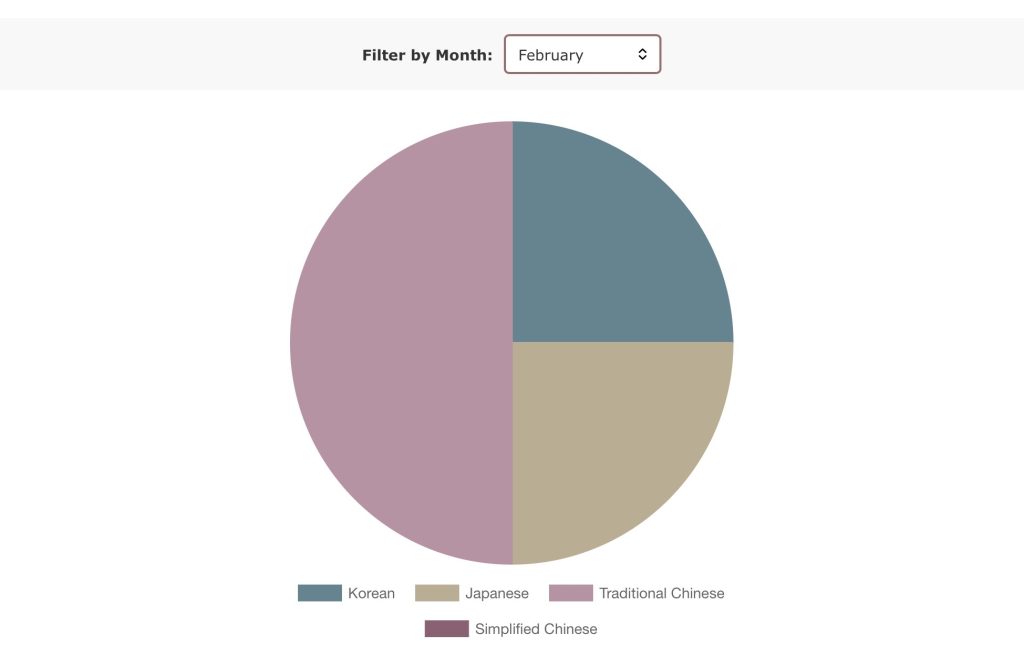
Traditional Chinese wins again! I think that my on-going Readmoo reading challenge is playing a role here, but it’s still more even than it was last year.
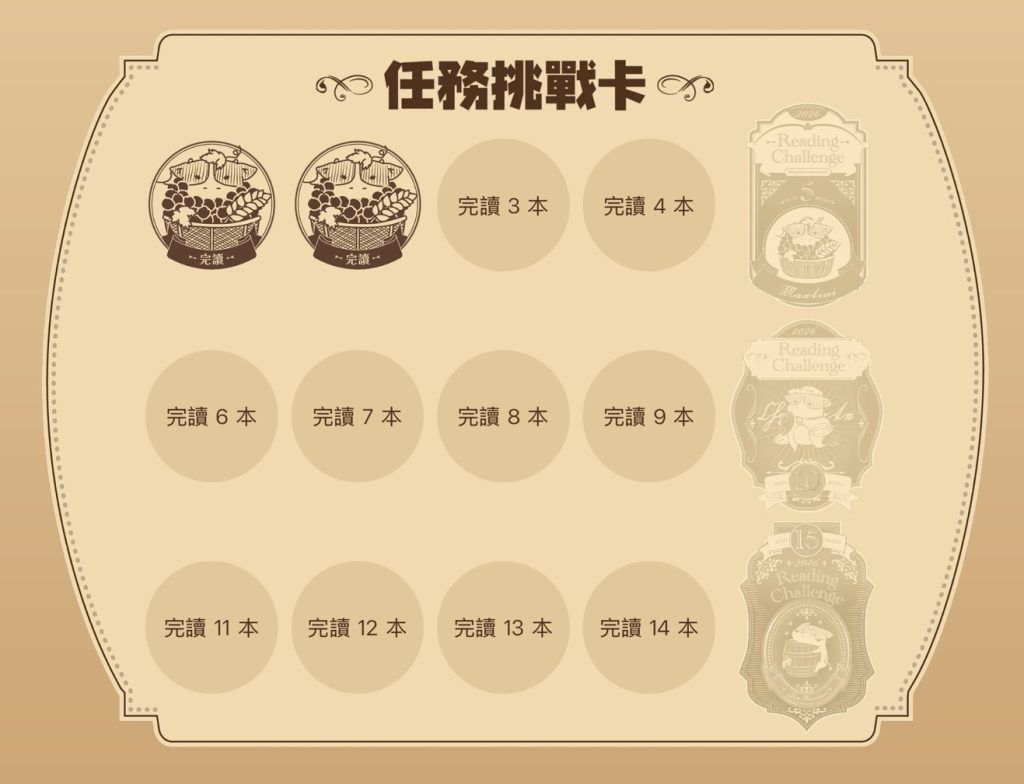
And the two Taiwanese novels were part of the Readmoo Reading Challenge, so I finally have some progress to show:
Books finished
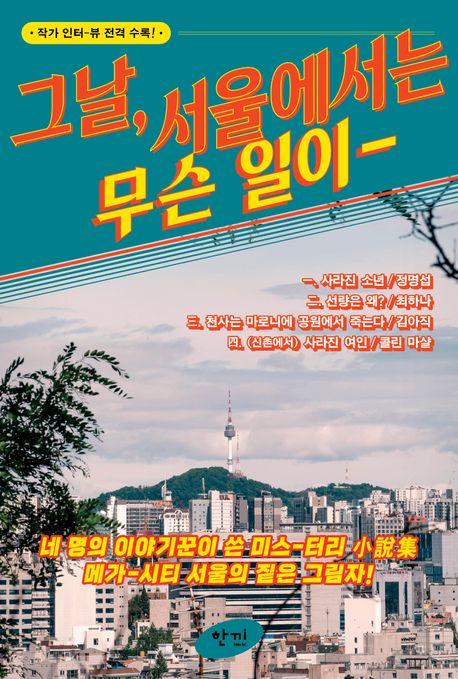
그날, 서울에서는 무슨 일이.
This is a collection of short stories by various authors on the common theme of Seoul. The short stories are:
- 사라진소년 – 정명섭 > Gaebong-dong (개봉동) and Gaeung-san (개웅산)
- 선량은 왜? – 최하나 > Yeonhui-dong (연희동)
- 천사는 마로니에 공원에서 죽는다 – 김아직 > Daehangno (대학로)
- (신촌에서) 사라진 여인 – 콜린 마샬 > Shinchon (신촌)
I loved all the short stories in this collection, but the first two ones are my favourites because they are the ones that checked both boxes: writing an engaging mystery and integrating Seoul in the plot (and not just use the city as background).
They were both fantastic, and they both addressed the rapid urban development of Seoul, the disparition of old neighbourhoods in favour of new apartment buildings. If these are topics you’re interested in, I highly recommend reading the second short story, 선량은 왜?. The story is set in Yeonhui-dong, but it could be set in many other places in Seoul.
The first short story, 사라진소년, was extraordinary good. There was a good mystery, and I loved our duo of main characters and the generational gap you can feel through their interactions. The neighbourhood described felt very nostalgic, and last but not least, the story is partially about Unit 684 and the Shimil-do incident. It was horrifying to learn about it.
천사는 마로니에 공원에서 죽는다 was probably the most interesting one in terms of mystery as we have a murder case and a real police investigation. The city background, though important to the plot, was not as dramatically essential as the first two stories, and I personally can’t stand the trope of the (very!) young genius detective, though I do understand the author’s motivation to give young female characters a strong role rather than depicting them as victims as if often the case in thrillers (as stated in the afterwords).
And finally, (신촌에서) 사라진 여인 was kind of the reverse: the city is at the heart of the story, but the mystery was underwhelming. Colin Marshall wrote this story in Korean, which is very impressive, and it gives the point of view of a foreigner in Korea, so it gives a completely new perspective and is a great addition to the collection. But maybe it was less interesting to read to me as it would be for a Korean reader? And it felt more like a succession of short essays (each describing experiences you typically go through as a foreigner living in Korea) rather than fiction to me.
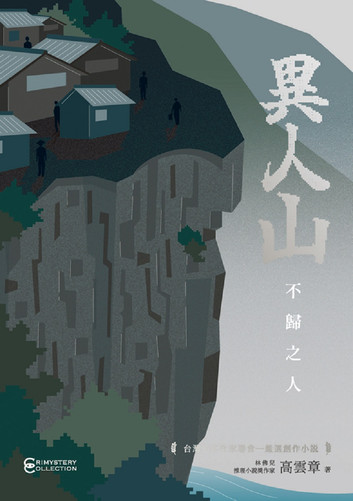
異人山 (不歸之人) by 高雲章
I read this book for the Readmoo reading challenge, and it was such a great discovery! The book is actually composed of a short story 同客車 and a novel 異人庄消失之謎, both featuring the same protagonists, a duo of American reporters who like to describe themselves as citizens of the world. I loved this duo so much, there’s such a strong bond between them, often just a look is enough to confirm that they are thinking the same thing.
But the novel really shines in the setting, a remote village first founded by Japanese engineers during the Occupation, where people who are fleeing their past life can find refuge. The novel starts with a mystery, but as we spend time in the village, we get to know the people living there, those who grew up in the village, and those who arrived after. Our protagonists learn about their past and what they are fleeing while solving crisis and helping people.
I thought that the novel had lost track of its initial mystery and that it was actually just a pretext to describe the village and its inhabitants. But I was so wrong! And what is more, our two protagonists never lost track of why they were here in the first place and they never stop investigating. It turns out that I, the reader, was the only one who got completely sidetracked, so the end was a shock to me, I was completely taken by surprise.
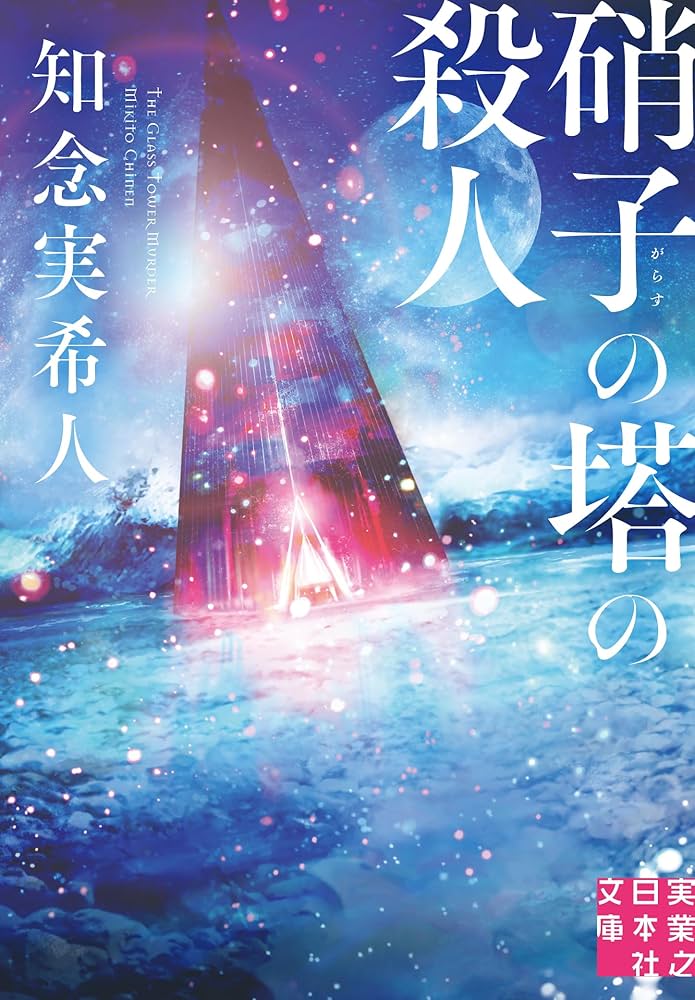
硝子の塔の殺人 by 知念実希人
When I read the first 100 pages of this novel, I thought it would be my favourite book of the year. It was clear right from the start that the book was an hommage to the honkaku mystery, it plays will all the tropes, it’s filled with references, and it has a humorous tone while presenting an exciting mystery.
But the more I read, the more the excitement from the first pages turned into boredom. It’s very difficult to explain what I didn’t like without spoilers, so I won’t go into details.
Some things that I can talk about though are the length of the novel and the repetitions. I feel like there were a lot of repetitions in the dialogues, each character having to say their “typical” lines before we could move on. I found it was very tiring to read, and the novel, which is very long to begin with, felt even longer to me. The locked-room mystery is also a central part of the novel, and I think I don’t like locked-room mysteries all that much. I am exactly the opposite of our fictional detective, I’m fascinated with the “why”, not the “how”, I want to know about the characters’ motives and state of mind, their psychological evolution and the external circumstances that turned an ordinary person into a murderer. Locked-room mysteries are generally all about tricks and the motives are often unconvincing or barely touched upon.
And as I said earlier, I don’t really like the character of the genius detective. In this novel though, it was much worse than that: the private detective was extremely annoying. I just couldn’t stand her, and we have 500+ pages to go through.
So overall, I did not enjoy reading this book, but I kind of admire the concept. The best way to describe it is that, as a lover of honkaku mysteries, I found this book very interesting, the concept and the end were very good and inventive, but as a reader of mystery novels, I didn’t like the end, and I did not enjoy reading the book.
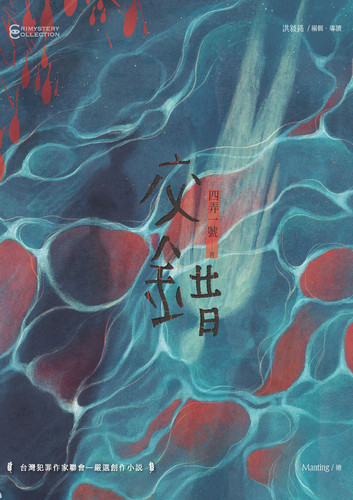
交錯 by 四弄一號
This book was so much more my kind of book than the previous one, and it was a relief to find myself in a hardcore police procedural. I loved this one so much, it was perfect. The investigation felt very realistic, the police working with available means, the characters all have interesting backgrounds and relatable motives, and the investigation progresses as we find more clues, connect the dots, learn about past events to finally find the murderer. No insane twist nor mind-blowing tricks, just a solid, suspenseful and convincing investigation (though there was also a good mystery that puzzled the investigators, and the reader!, for some time).
There’s not much else to say, I thought that 異人山 would be my favourite book of the month, but I love police procedurals so much… I think 交錯 has to be this month’s favourite.
交錯 was also part of the Readmoo Reading Challenge.
And that’s it for February! Overall I’m very happy with my readings this month, I read in all three languages, I finally finished 硝子の塔の殺人 that I started in December of last year, and I read two books for the Readmoo challenge.
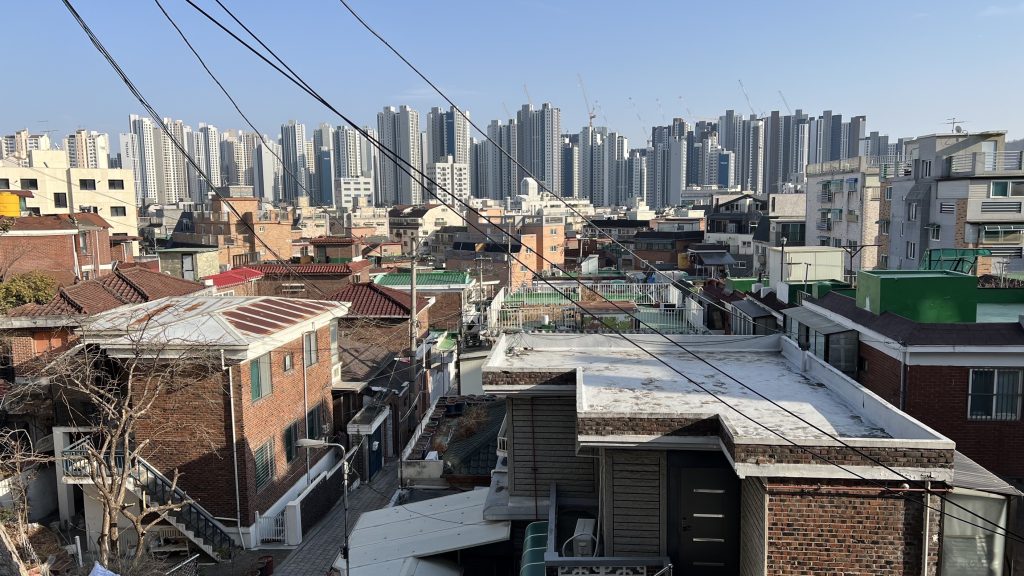
Oh, and this is a picture I took in Gaebong-dong, I think it illustrates perfectly Seoul’s urban landscape with old neighbourhoods in the foreground vs high-storey apartment buildings that grow like mushrooms in the background.
About

I’m learning Japanese, Korean and Chinese to read mystery novels and play video games in these languages.
Learning languages has always been one of my favourite hobbies, but I’m not a social person, I don’t like to meet new people and make friends, this is just not me. I keep hearing that languages are meant for communication, that we have to actively use them, talk with natives, etc. and for a long time, I thought it was weird to learn languages just to read books, with zero interest in communication.
Now I don’t really care what people think, and this blog helped me a lot to stop doubting myself and just do what I enjoy doing.
Hey Inhae,
Thank you for keeping this blog going! It’s very inspiring. I’ve been studying Japanese for a few years and I also tried both Korean/Chinese last year, but I couldn’t keep up with the workload. Seeing your posts gets me excited to try again. Reading multiple books in multiple languages would be a dream. Keep on keeping on!
Thank you so much for your comment!
Good luck with your Korean and Chinese studies! We’ve got this ^^